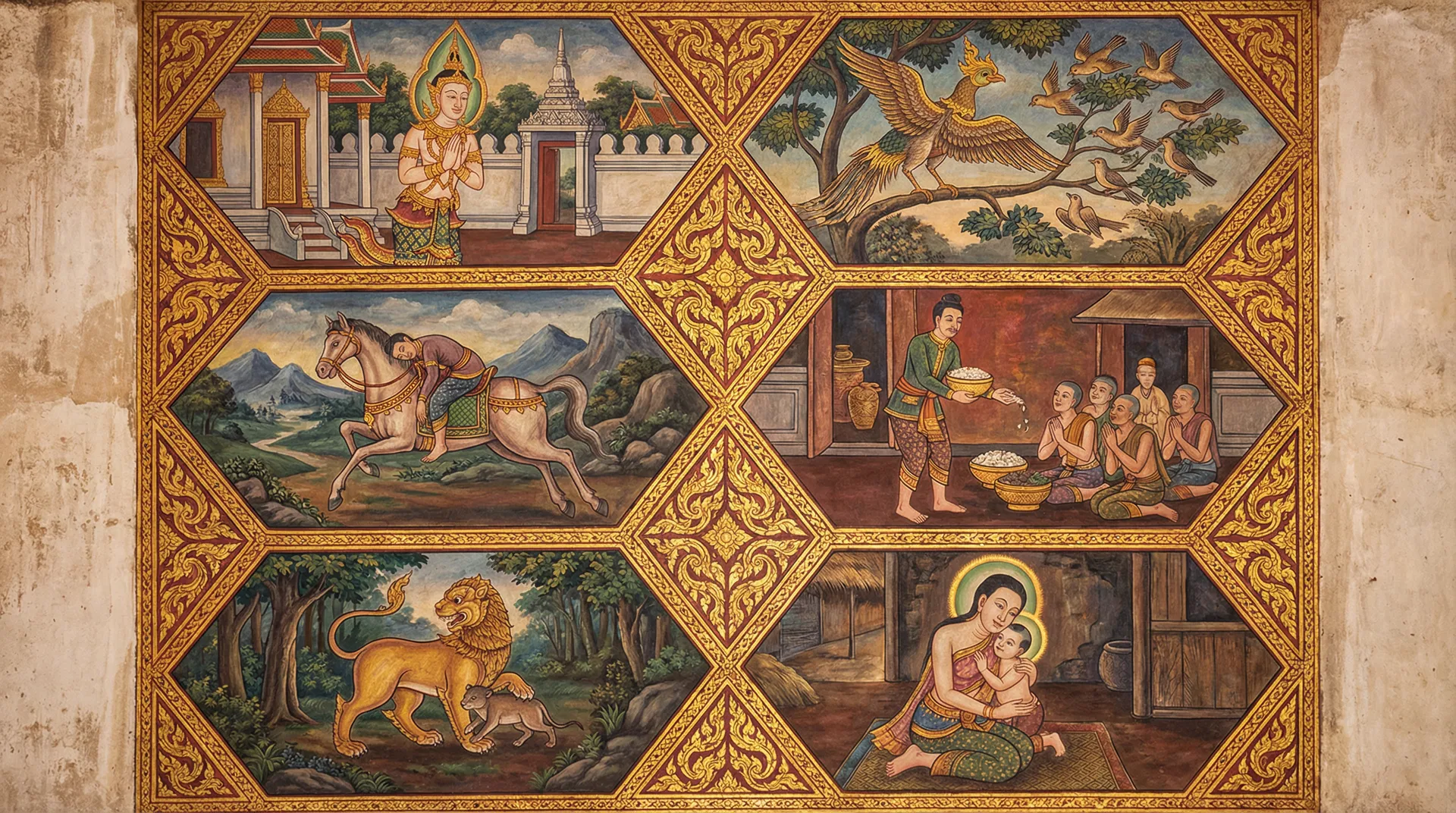
Mahāpaduma Jātaka
Mahāpaduma Jātaka
In the ancient and prosperous kingdom of Mithila, ruled King Janaka, a monarch whose reign was characterized by justice, wisdom, and an unwavering commitment to the welfare of his people. His kingdom was a tapestry of thriving towns and villages, its people living in harmony and prosperity. Yet, beneath the veneer of peace, the shadows of desire and deception could still cast their dark spells.
In one of his innumerable past existences, the Bodhisatta was born as Prince Mahāpaduma, the eldest son of King Janaka. Prince Mahāpaduma was a young man of extraordinary beauty, intelligence, and virtue. His demeanor was gentle, his heart pure, and his understanding of the Dhamma profound. He was beloved by his father, his mother, and indeed, all the inhabitants of Mithila.
However, the king's second wife, Queen Candra, harbored a secret and destructive obsession. She was consumed by an illicit desire for the virtuous Prince Mahāpaduma. Her heart, blinded by lust, yearned for him, even though he was her stepson. She was a woman of cunning and manipulative intent, her outward beauty masking a heart corrupted by unwholesome desires.
One day, Queen Candra, unable to contain her forbidden longing any longer, summoned Prince Mahāpaduma to her chambers under a false pretense. She attempted to seduce him, her words laced with honeyed deceit and her eyes filled with wicked intent. Prince Mahāpaduma, utterly repulsed by her advances and deeply disturbed by her transgression, firmly rejected her advances. "Madam," he declared, his voice filled with righteous indignation, "your words are a poison to the ears, and your desires are a stain upon the honor of this royal house. I am your stepson, and I will never betray the trust placed in me. I implore you to abandon these unholy thoughts and return to the path of righteousness."
Faced with rejection, Queen Candra's lust twisted into a venomous rage. Her desires, unfulfilled, festered into a burning hatred. Humiliated and furious, she devised a wicked plan to destroy the prince. She knew that she could not harm him directly, but she could twist the truth and plant seeds of doubt in the king's mind.
The very next morning, Queen Candra presented herself before King Janaka, her face contorted in feigned grief and terror. "My Lord," she wailed, her voice choked with manufactured sobs, "a terrible misfortune has befallen me. Last night, your own son, Prince Mahāpaduma, entered my chambers with wicked intent. He attempted to force himself upon me! I fought him with all my might, but alas, I am but a weak woman. If not for my pleas, I do not know what horrors I would have endured."
King Janaka, a just ruler, was shocked and deeply saddened by his wife's accusation. Though he loved his son dearly, the queen's tears and her seemingly genuine distress convinced him of her story. He summoned Prince Mahāpaduma, his heart heavy with suspicion and grief. The prince, bewildered and hurt by the false accusation, vehemently denied the queen's claims. "Father," he pleaded, his voice trembling with emotion, "I swear upon my honor, I have never harbored such thoughts, nor have I ever acted with such dishonor. Queen Candra lies!"
However, Queen Candra's manipulative performance had been too convincing. The king, blinded by his wife's deception and the perceived innocence of her tears, could not bring himself to believe his son's protestations. In his misguided anger and sorrow, he made a terrible decision. He banished Prince Mahāpaduma from the kingdom, ordering him to never return, lest he face a far worse fate.
Heartbroken and unjustly accused, Prince Mahāpaduma, the Bodhisatta, accepted his fate. He left Mithila, his heart heavy with sorrow but his spirit unbroken. He wandered through forests and mountains, living a life of austerity and meditation, his mind focused on the Dhamma and the eventual clearing of his name.
Meanwhile, in Mithila, Queen Candra's wicked plan continued to unravel. Her guilt and her deception weighed heavily upon her. She found no peace, her mind tormented by the consequences of her lies. She became increasingly ill, her outward beauty fading as her inner turmoil grew. She confessed her deceit to her attendant, a loyal servant who, horrified by the queen's actions, resolved to do what was right.
The attendant, with great courage, sought out King Janaka and revealed the truth of Queen Candra's wicked plot. She recounted the queen's lustful desires, her failed seduction, and her subsequent malicious accusation against the noble prince. King Janaka, upon hearing this devastating revelation, was filled with profound remorse and grief. He realized the terrible injustice he had inflicted upon his innocent son.
The king, consumed by regret, immediately dispatched messengers throughout the land, seeking to find his banished son. He offered a great reward for any news of Prince Mahāpaduma. The messengers searched far and wide, and finally, after much hardship, they found the prince living as a hermit in the remote forests.
Upon hearing that his name had been cleared and that his father sought his return, Prince Mahāpaduma agreed to come back to Mithila. He returned not with anger or resentment, but with a heart filled with compassion for his father's misguided actions and for the suffering caused by Queen Candra's lust and deceit. He returned to restore peace and righteousness to his kingdom.
King Janaka, overwhelmed with remorse, begged for his son's forgiveness. He acknowledged his error and the suffering he had caused. Prince Mahāpaduma, in his infinite compassion, forgave his father. Queen Candra, her deceit exposed and her spirit broken, met her end consumed by her own guilt and the consequences of her wicked actions.
The Mahāpaduma Jātaka serves as a powerful lesson on the destructive nature of lust, deceit, and false accusations. It highlights the importance of truth, justice, and the profound forgiveness that can arise from a virtuous heart. The Bodhisatta, in his role as Prince Mahāpaduma, exemplified unwavering virtue and ultimate compassion, even in the face of profound injustice and suffering.
— In-Article Ad —
💡Moral of the Story
Lust, deceit, and false accusations lead to immense suffering, while truth, justice, and forgiveness ultimately prevail.
Perfection: Patience (Khanti) and Wisdom (Paññā)
— Ad Space (728x90) —
More Jataka Tales You May Enjoy
 400Sattakanipāta
Mahosadha Jataka
Mahosadha JatakaIn the ancient kingdom of Mithila, a city famed for its wise ruler, King Vedeha, the...
💡 Exceptional intelligence, when coupled with foresight, justice, and compassion, is the greatest asset for ensuring the well-being, prosperity, and peace of a kingdom and its people.
 201Dukanipāta
Nimi Jataka
Nimi Jataka In the heart of a magnificent kingdom, ruled a just and wise king named Nimi. His reign ...
💡 Even the highest celestial pleasures are impermanent and subject to the law of karma. True happiness and liberation are found in understanding and practicing the Dhamma, leading to the cessation of suffering.
176DukanipātaMahāsuka Jātaka
Mahāsuka JātakaIn the ancient city of Mithila, nestled amidst lush gardens and bustling marketplaces...
💡 True happiness is not found in external possessions or fleeting pleasures, but in the cultivation of inner peace, wisdom, and virtue. The greatest treasure is the joy of a contented mind, free from the bondage of insatiable desires.
 88Ekanipāta
The Great Dream Jataka
In ages past, when the Bodhisatta was cultivating his perfections, he was born as King Brahmattat, a...
💡 Blind suspicion and unfounded jealousy, fueled by deceit, can lead to great injustice. Truth and righteousness, patiently sought and revealed, are the only paths to healing and true reconciliation.
193DukanipātaSarbhangajataka
Sarbhangajataka In the venerable city of Varanasi, where the Ganges flowed like a silken ribbon and ...
💡 Truth and virtue, when deeply rooted, cannot be destroyed by falsehood or malice. Those who spread lies and sow discord ultimately reveal their own corrupt nature.
109EkanipātaSutasoma Jataka
The Tale of the Compassionate Prince and the Hungry Ogress In the grand kingdom of Gandhara, renowne...
💡 True compassion understands and alleviates suffering, even in the face of fear. Selfless kindness can transform even the most hardened hearts.
— Multiplex Ad —